
A recent study by scientists indicates that the Hindu Kush-Himalaya region is experiencing increased frequency and intensity of extreme weather events due to climate change, including rapid glacial melting and changing rainfall patterns. However, the research also cautions against solely blaming climate change, highlighting that human factors like population growth, commercial activities, and non-enforcement of regulations contribute significantly to the vulnerability and impact of these disasters. The study points out that many devastating floods originate from small glaciers and rain-fed streams, exacerbated by encroachment on unstable slopes and floodplains.

Climate scientist Tapio Schneider advocates for expanding early warning systems beyond rainfall events to include other disaster triggers like flash floods, citing the recent Nepal floods. He highlights the inevitability of 1.5 degrees Celsius global warming and discusses the role of advanced climate modelling and AI in improving predictions and research, particularly for regions like India.

Heavy rainfall, floods, landslides, and an avalanche have claimed at least 27 lives across Nepal in recent days, with four people missing and eight injured. The monsoon-induced incidents have destroyed hundreds of homes and damaged infrastructure, highlighting the country's vulnerability to such natural disasters, following last month's devastating flash floods.

Cyril Radcliffe drew India's border without ever visiting it. Turns out our environmental clearance system learned the same trick -- and the Western Ghats are paying for it, points out Binu Alex.

It has offered a rare moment of relief, allowing them to sit down, talk, smile and feel human again amid days of uncertainty and hardship.

'Without that one critical irrigation, the entire crop can be lost.'

'Hydro-seismicity is a phenomenon that typically shows up during and just after the monsoon.' 'Heavy rain causes water to percolate deep into the rock, and where there are fractures, that water fills the pores and builds up what we call pore water pressure.' 'That pressure can widen existing cracks, and eventually the rock gives way -- which surfaces as tremors.'

Heavy monsoon rains have severely impacted Mumbai and its surrounding areas, leading to landslides, suspension of train services, and at least 13 fatalities over the past few days. The Mumbai-Pune Expressway was also shut due to a concrete pillar collapse and waterlogging.

Torrential monsoon rains unleashed widespread destruction across several parts of the country on Thursday, inundating roads, uprooting trees, damaging property and disrupting normal life as authorities scrambled to restore normalcy.

'The drought situation of Maharashtra is more severe than in 1972.'
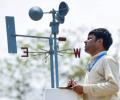
'This system will be of immense help in agricultural planning, disaster management and water resources management.'

Nepalese authorities have issued a flood alert for central, western, and eastern parts of the country as water levels in major rivers like Sun Koshi, Budhi Gandaki, Mahakali, and Marsyangdi have crossed alert and danger levels due to continuous monsoon rainfall, urging residents to remain vigilant.

'Nobody can say a quake will strike on a particular day or month. It remains a natural event, governed by factors that are only partly understood, even by researchers working on this across the world.'

Search and rescue operations are continuing for a second day in Mumbai following a landslide in the Sakinaka area that claimed seven lives and injured seven others. Two individuals are still feared trapped, with rescue efforts complicated by narrow access and the inability to use heavy machinery.

'In the wake of this tragedy, India will provide power to Nepal if and when the requirement for the same is communicated to India as per their needs.'

Tamil Nadu Chief Minister C Joseph Vijay opened the sluices of the Stanley Reservoir in Mettur on Tuesday for irrigation in the Cauvery delta districts.

Torrential rains have caused widespread devastation across several Indian states, leading to at least 11 deaths in Assam and Uttarakhand, pushing rivers above danger levels, and disrupting daily life with landslides, floods, and school closures. States like Jharkhand, Uttar Pradesh, Himachal Pradesh, Delhi, West Bengal, and Jammu & Kashmir are also grappling with the monsoon fury, while Meghalaya faces an unusual rainfall deficit.


Dilip Buildcon Ltd, the contractor for the Anakkampoyil-Kalladi-Meppadi road tunnel project in Wayanad, attributed a recent fatal landslide to exceptionally heavy rainfall. The company stated that the project adheres to all safety and environmental protocols, despite allegations from Kerala Ministers of a "man-made disaster."

Floods have forced hundreds of government schools across Bihar to shut, disrupting studies for thousands of students.

A single night of deadly floods wiped out an entire village in Assam, leaving families without homes, cattle or hope.

Bollywood superstar Salman Khan has initiated a multi-phase relief drive through his Being Human organisation and fan club in Assam, providing food, medicines, and essentials to families affected by devastating floods, with plans for long-term rehabilitation support.

The weather office has warned that the prevailing monsoon conditions could trigger flash floods, landslides, waterlogging and a further rise in river levels across the Northeast.

Relentless monsoon rains have submerged roads, homes and public spaces across various cities of Gujarat bringing normal life to a standstill.

A 70-year-old man, Balaiah, was washed away after allegedly falling into an open manhole in Hyderabad following heavy rainfall. Rescue operations are underway to trace him. This incident follows another recent drowning tragedy in Telangana where four youths drowned in the Sri Ram Sagar Project.

Heavy rainfall has disrupted major pilgrimages in Uttarakhand, including the Kedarnath route and the Kailash-Mansarovar Yatra, prompting the IMD to issue red and orange alerts for extremely heavy rainfall across several districts.

A new study indicates that India's monsoon season could experience a significant increase in uncompensable heat stress under a 2 degrees Celsius global warming scenario, extending the duration of extreme heat conditions.

Heavy monsoon rains have severely impacted Thane and Palghar, Mumbai's neighbouring districts, causing extensive waterlogging, tree and wall collapses, and prompting significant rescue efforts, including the tragic death of a six-year-old child.

Mumbai experienced heavy overnight monsoon rains, with some areas receiving over 200 mm in 24 hours, leading to widespread waterlogging, traffic congestion, and disruptions in suburban train services, particularly on Central Railway lines due to a track cave-in.

Union Minister Jitendra Singh launched two advanced weather forecast products developed under the Ministry of Earth Sciences (MoES), aimed at delivering hyper-local, impact-based and artificial intelligence (AI)-driven weather services across India.

Mumbai and its metropolitan region are experiencing severe monsoon rains, leading to widespread waterlogging, transport disruptions, and the closure of schools and colleges. The India Meteorological Department (IMD) has issued an 'extremely heavy rainfall' alert, with some areas receiving nearly 200 mm of rain in 12 hours, prompting Chief Minister Devendra Fadnavis to urge residents to avoid non-essential travel.

The water rose from knee level to chest height within minutes before climbing even higher. Homes crumbled, cattle sheds collapsed and everything that could be carried away by the current vanished.

The India Meteorological Department has issued a 'red' alert for Mumbai, Thane, and Raigad districts, forecasting heavy to very heavy rainfall and strong winds. Residents are advised to avoid unnecessary travel, and warnings include potential flash floods, structural damage, and disruptions to essential services. The Brihanmumbai Municipal Corporation has also urged caution and deployed officials to monitor the situation.

'We should expect extreme heat, extreme rains, floods, landslides and maybe cyclones. Not just this year, in the coming year as well.'

Himachal Pradesh has been severely affected by flash floods, cloudbursts, and landslides since the monsoon began. At least 52 people have died, and search operations are underway for those missing.

A 55-year-old man died after falling into an open manhole in Mumbai during heavy rains, leading to the Brihanmumbai Municipal Corporation (BMC) suspending four officials and initiating a homicide case against the responsible contractor for alleged negligence.

West Bengal Chief Minister Suvendu Adhikari announced the state government will move the Supreme Court to vacate the stay on a CBI probe into the alleged Gorkhaland Territorial Administration teacher recruitment scam. The decision follows complaints of corruption and illegal teacher recruitment within the GTA.

Maharashtra Deputy Chief Minister Eknath Shinde on Monday attributed early arrival of the southwest monsoon and heavy rainfall in a short span for the inundation of low-lying areas in Mumbai, which disrupted road and railway traffic.

Seven people, including two children, died and seven others were injured when a compound wall of Bowring and Lady Curzon Hospital in Bengaluru collapsed due to heavy rains. Karnataka's Chief Minister has ordered an inquiry into the incident and announced compensation for the victims' families.

Normally, the southwest monsoon makes its onset over Kerala by June 1 and covers the entire country by July 8. It starts retreating from northwest India around September 17 and withdraws completely by October 15.
